UPSC Prelims negative marking: when a guess pays, with the maths
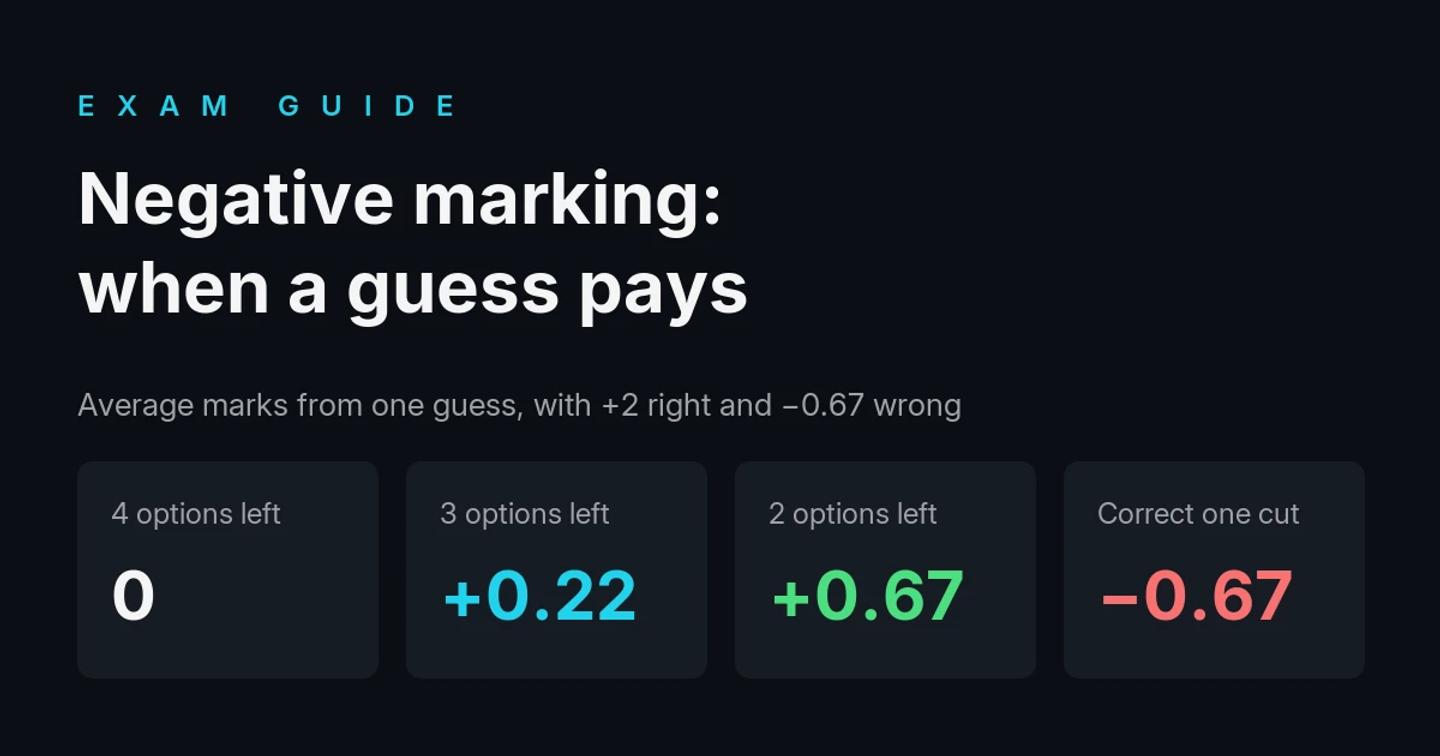
In UPSC Prelims a wrong answer costs two-thirds of a mark, so a blind guess among four options is worth exactly zero on average. Cut one wrong option and a guess is worth +0.22; cut two and it is worth +0.67. Guess only when you are more than 25% sure.
 Keshav Melnad
Every aspirant hears the same advice: "Don't guess blindly. Guess only if you can eliminate options." It is good advice. But almost nobody shows why it is true, or how much one elimination is actually worth. Without the working, the advice turns into a feeling, and feelings change in the exam hall.
So here is the working. It needs only school arithmetic, and once you see it, you will not need to remember any rule.
What UPSC's paper says
The rule is printed on the cover of every GS Paper I booklet. In the 2025 paper, instruction 10 says:
- Each question has four alternatives.
- For a wrong answer, one-third of the marks for that question is deducted as penalty.
- If you mark more than one answer, it is treated as a wrong answer, with the same penalty.
- If you leave a question blank, there is no penalty.
The paper has 100 questions for 200 marks, so each question carries 2 marks. One-third of 2 is two-thirds of a mark, which is about 0.67. So for every question you have three outcomes: +2 if right, −0.67 if wrong, 0 if left blank.
You can read the instructions yourself in UPSC's official question paper for 2025.
A blind guess is worth exactly zero
Suppose you have no idea at all and pick one of the four options. You will be right one time in four and wrong three times in four. On average:
- Right: 1/4 × 2 = +0.5
- Wrong: 3/4 × 2/3 = −0.5
- Total: 0
The numbers work out this way because each question has one right option and three wrong ones, and the penalty is one-third of the marks. So a blind guess does not lose marks on average, but it does not gain any either. It only adds luck to your score, good or bad.
Each option you cut adds marks
Now suppose you are sure one option is wrong. Three options are left, so a guess is right one time in three:
- Right: 1/3 × 2 = +0.67
- Wrong: 2/3 × 2/3 = −0.44
- Total: +0.22
If you can cut two options and you are left with two:
- Right: 1/2 × 2 = +1
- Wrong: 1/2 × 2/3 = −0.33
- Total: +0.67
So cutting one option makes a guess slightly positive. Cutting two makes it clearly worth it: on average, three such guesses earn you about 2 marks, the same as one question answered with full confidence.
The one number to remember: 25%
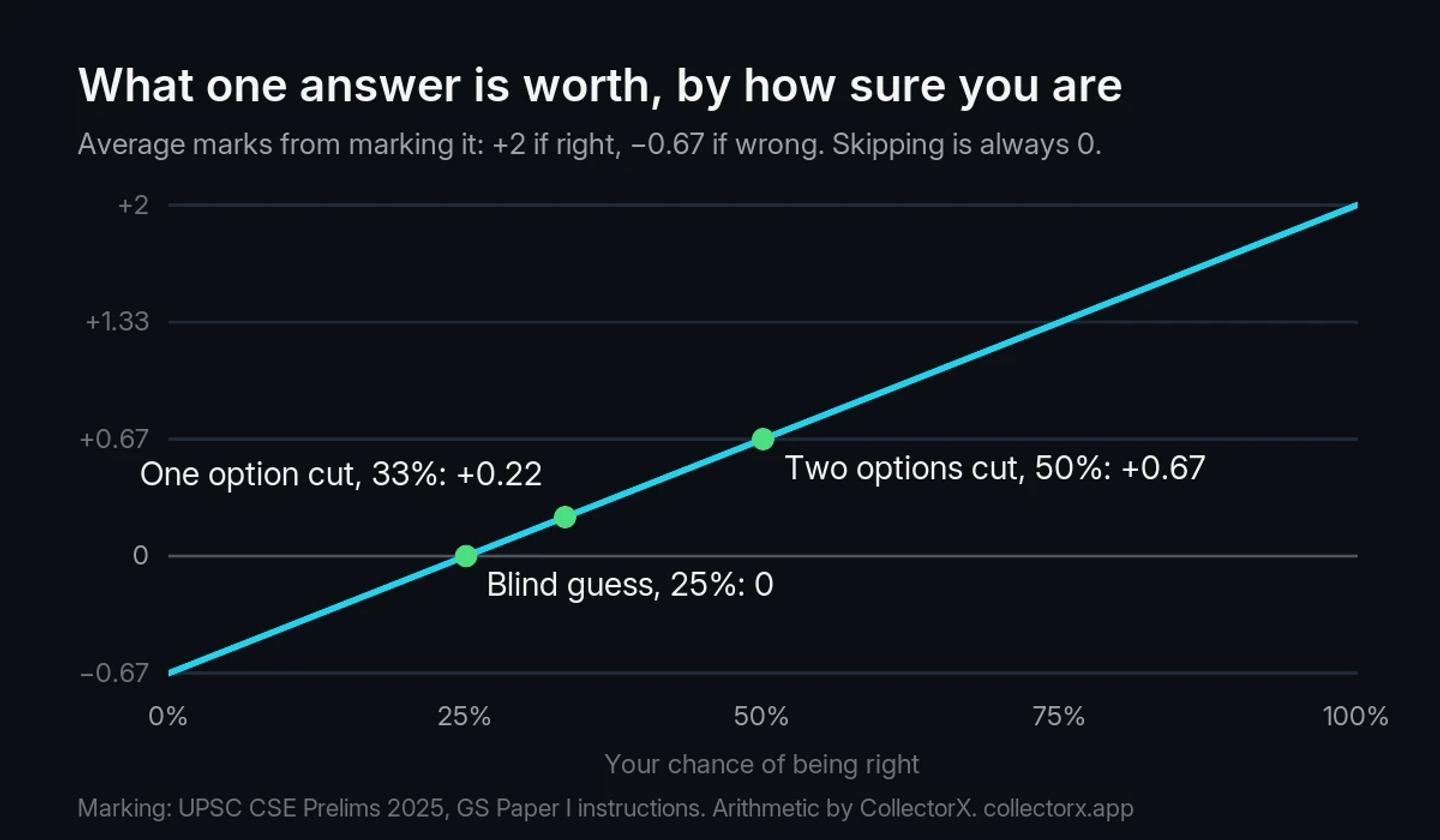
Put the two cases together and one rule comes out. Answering a question is worth it when your chance of being right is more than 25%. Below 25%, leave it blank. At exactly 25%, it makes no difference on average.
You do not need to count options to use this. Ask yourself one honest question: "If I marked this, would I be right more than one time in four?" If yes, mark it. If you truly cannot say, you are at 25%, and leaving it blank costs you nothing.
A real PYQ, worked through
Here is question 86 from the 2025 GS Paper I (Series A):
Consider the following statements with regard to pardoning power of the President of India :
I. The exercise of this power by the President can be subjected to limited judicial review.
II. The President can exercise this power without the advice of the Central Government.
Which of the statements given above is/are correct?
(a) I only (b) II only (c) Both I and II (d) Neither I nor II
Suppose you do not remember anything about judicial review of pardons. But you do remember Article 74 from your polity reading: there is a Council of Ministers to aid and advise the President, and the President acts in accordance with that advice.
That one fact tells you statement II is wrong. So (b) and (c) are gone, because both say II is correct. You are left with (a) or (d), which means you only have to decide whether statement I is true.
Even if you are completely unsure about statement I, a guess here is a 50:50 guess, worth +0.67 on average. Leaving it blank gives 0. So you should mark it.
UPSC's official answer key for 2025 gives (a) I only.
Notice what happened. You knew only half the question, and that was enough to make marking it the right decision. This is how elimination works in two-statement questions: each statement you are sure about removes two options at once.
Where elimination stops working
Since 2022, UPSC has asked many questions in the "how many of the above" format. In GS Paper I, my count from UPSC's papers is 8 such questions in 2022, 47 in 2023, 17 in 2024 and 27 in 2025. I showed this count as a chart in my post on AI tools for UPSC Prelims.
In these questions, the options count the correct statements: "Only one", "Only two", "All three" and "None" when there are three statements, or "Only one" to "All four" when there are four. Here, each statement you are sure about removes at most one option. With three statements, knowing that one is true removes only "None", and knowing that one is false removes only "All three". To bring the question down to two options, you must be sure about two of the three statements. With four statements, you need even more.
Compare this with question 86 above, where one statement was enough to reach 50:50. The same partial knowledge often leaves you at three options in a "how many" question. Be more careful with these. Count honestly how many options you have really cut.
Two traps that the maths does not show
First, a wrong elimination costs you. All the numbers above assume that the option you cut is really wrong. If you cut the correct option by mistake, your guess cannot be right, and you lose 0.67 every time. This is the most common way aspirants lose marks to guessing: not blind guesses, but confident eliminations that were wrong.
Second, these are averages. Over many questions, +0.67 per 50:50 guess is what you will get. On one paper, with only ten or fifteen such guesses, luck can push you above or below that. The maths tells you which decision is right. It cannot promise the result on the day.
Both traps come down to one thing: how good your "I am sure this option is wrong" feeling really is. Your "I am sure" may be reliable in polity and not so reliable in environment. You can only know this from your own record, not from a general rule.
How I practise this decision
This is the reason the review in CollectorX judges each decision, not only each answer. After every round, each question gets a verdict, such as a good skip, a risky attempt, or a timid skip in a topic where your record says you usually get it right. The verdict comes from your own past answers in that topic, so over time you learn where your 50:50 is really 50:50, and where it is not.
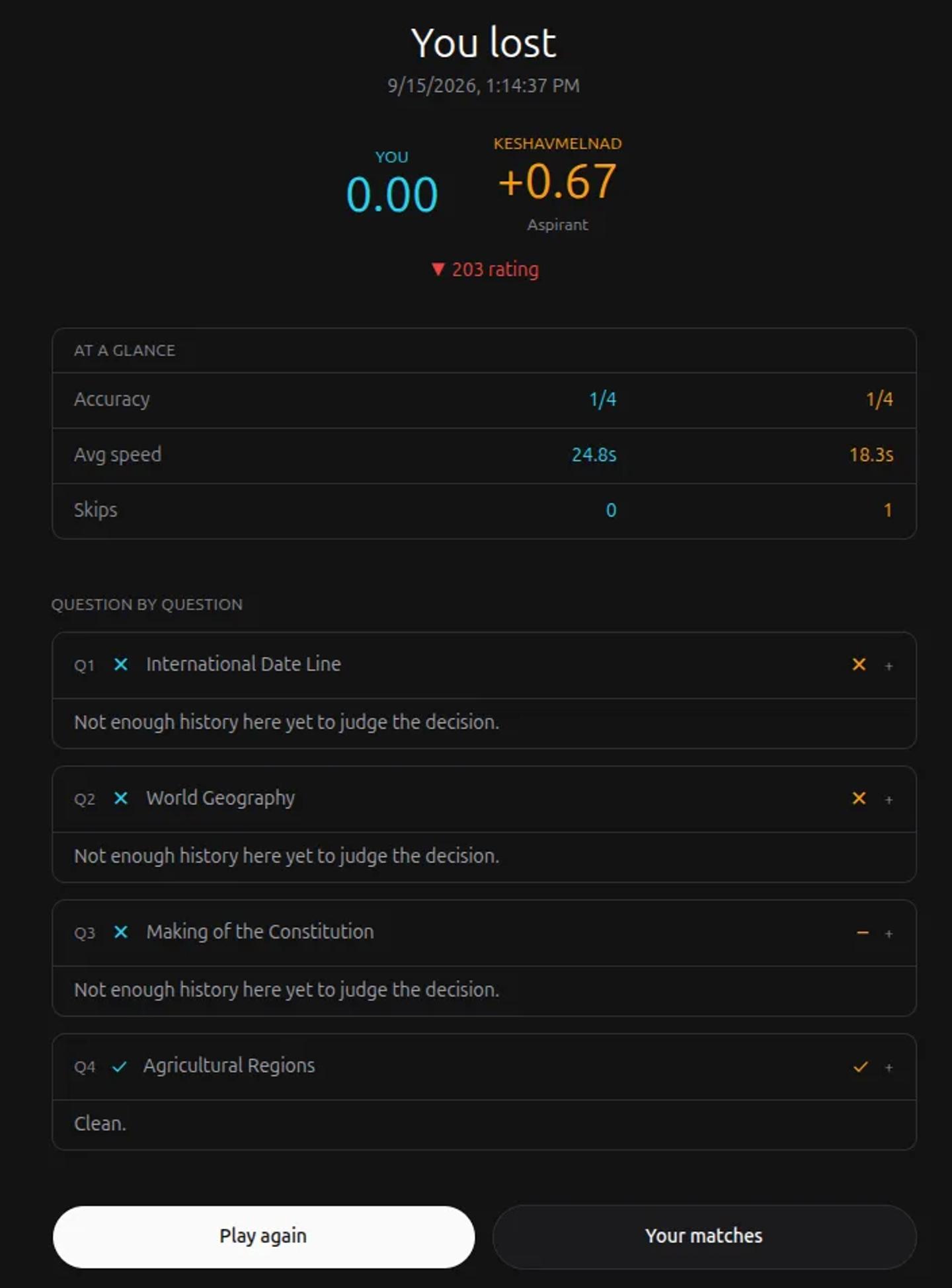
The marking in CollectorX is the same as UPSC's: +2, −0.67 and 0 for a skip. If you want to practise this one decision on real PYQs, open Solo Learn in Practice mode and choose a subject. Watch your skips as closely as your wrong answers.
Sources
- UPSC Civil Services (Preliminary) Examination 2025, General Studies Paper I, question paper — GS Paper I has 100 questions for 200 marks; each question has four alternatives; one-third of the marks for a question is deducted for a wrong answer; more than one answer counts as wrong with the same penalty; a blank answer carries no penalty (instruction 10, 2025 paper, Series A). (accessed 4 November 2026)
- UPSC answer key, Civil Services (Preliminary) Examination 2025, General Studies Paper I — The official answer to question 86 (Series A), on the President's pardoning power, is (a) I only; no question was dropped from the 2025 paper. (accessed 4 November 2026)
- Article 74: Council of Ministers to aid and advise President (Constitution of India, CLPR) — Article 74(1) provides a Council of Ministers with the Prime Minister at the head to aid and advise the President, who shall act in accordance with such advice. (accessed 4 November 2026)
- How to use ChatGPT, Gemini and Claude for UPSC Prelims (CollectorX) — “How many of the above” questions in GS Paper I: none from 2016 to 2021, 8 in 2022, 47 in 2023, 17 in 2024 and 27 in 2025, counted by CollectorX from UPSC's papers. (accessed 4 November 2026)
- How it works (CollectorX) — CollectorX marks +2, −0.67 and 0 for a skip, and the review gives each decision a verdict from the player's own record in that topic; Solo Learn has a Practice mode with UPSC's marking. (accessed 4 November 2026)

Keshav Melnad
Prepared for the UPSC Civil Services Examination for six years before building CollectorX on his own. He holds a PhD from IIT Bombay, and his research on Sanskrit astronomical texts is published in peer-reviewed journals.
Read next
How a CollectorX duel works, and why speed earns no marks
A CollectorX duel is marked exactly like UPSC Prelims: +2 for a right answer, −0.67 for a wrong one, 0 for a skip, and nothing for answering faster. If the marks are level, the round is a draw. Here is how a round works, step by step, and why speed decides nothing.
How to use UPSC PYQs properly, not just solve them once
PYQs will not tell you which topics come next year: in 1,000 GS Paper I questions from 2016 to 2025, most topics were asked in only one year. What PYQs teach is how UPSC asks. Solve them topic-wise, learn why every wrong option is wrong, revisit your mistakes, and sit full papers near the exam.
Your next duel can start now.
Solve real Prelims PYQs against another aspirant, or practise alone with the exam's own marking.