How a CollectorX duel works, and why speed earns no marks
A CollectorX duel is marked exactly like UPSC Prelims: +2 for a right answer, −0.67 for a wrong one, 0 for a skip, and nothing for answering faster. If the marks are level, the round is a draw. Here is how a round works, step by step, and why speed decides nothing.
 Keshav Melnad
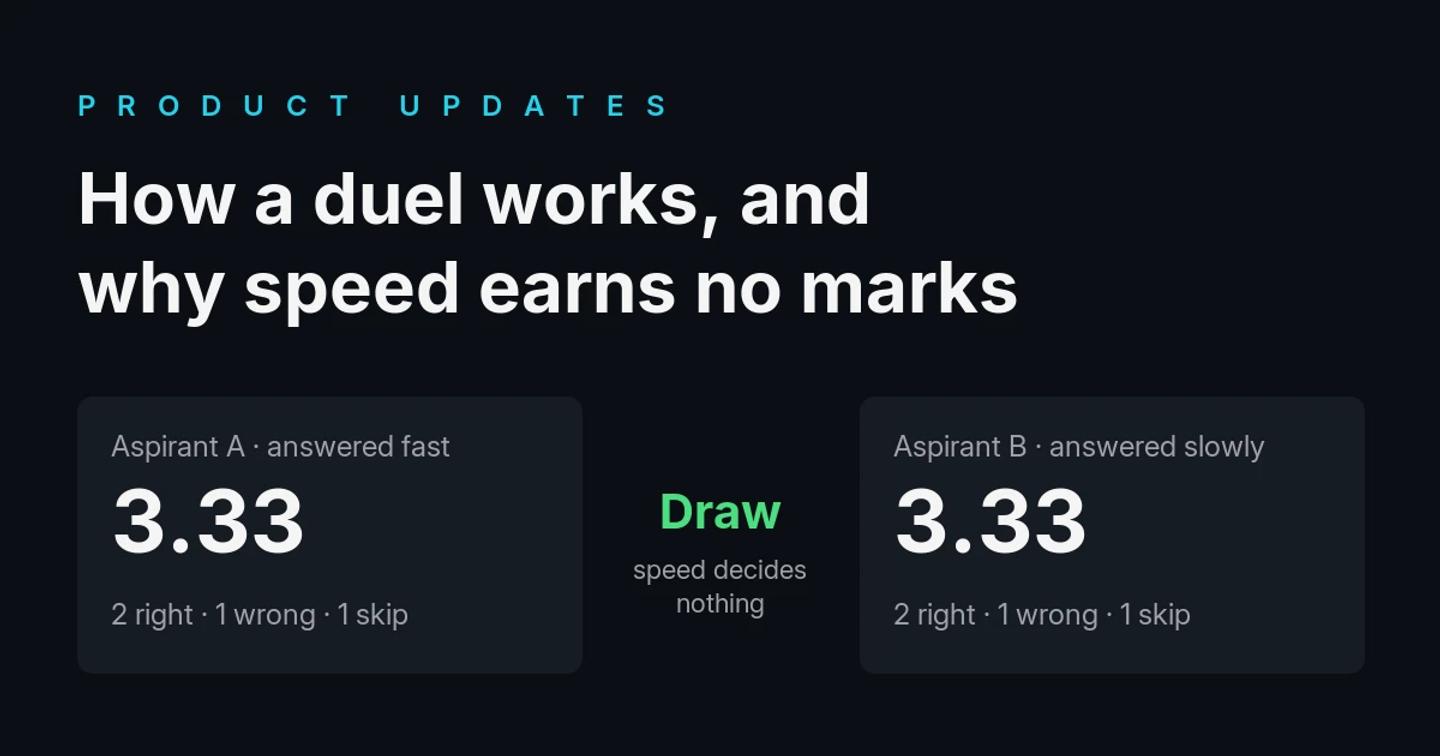
Two aspirants play a Standard round of four questions. Each gets two right, one wrong and skips one. Each scores 2 + 2 − 0.67 = 3.33. One of them finished every question much faster than the other.
In most quiz apps, the faster player would win. In CollectorX, this round is a draw. This post explains why I made that choice, and how a duel works from the moment you press the button to the review at the end.
Why speed earns no marks
UPSC gives you 120 minutes for 100 questions in GS Paper I. That is about 72 seconds a question on average. Time matters in the exam hall: you must finish the paper. But UPSC gives no marks for finishing early. Two aspirants with the same answers get the same score, whoever finished first.
There is a second, stronger reason. In my post on negative marking, I showed that a blind guess among four options is worth exactly zero on average. That is what keeps blind guessing in check. Now imagine an app that gives even a small reward for speed. A fast blind guess would then be worth more than zero, and more than a careful skip. The app would slowly train you to click quickly and guess, which is exactly the habit that UPSC's marking punishes.
So in a CollectorX duel, your speed is recorded and shown to you in the review, but it decides nothing. The marks decide the round. If the marks are level, it is a draw.
A duel, step by step
1. Finding an opponent
There is no lobby. You press Find an opponent, and the server looks for an aspirant rated within 50 points of you. If nobody is there, it slowly widens the search. If no suitable aspirant appears within fifteen seconds, you are offered a practice bot. The bot is clearly labelled and the round is unrated. You are never told that a bot is a person.
2. Choosing your pace
A statement question in Prelims takes time just to read, so one fixed clock for every question would test reading speed, not knowledge. So you choose the pace you want:
- Brisk: quick decisions, six questions.
- Standard: the default, four questions.
- Steady: more room to read, three questions.
- Exam pace: closest to the real paper, three questions and a longer round.
Within each pace, a harder question gets more time and an easier one gets less. You can accept more than one pace at a time, which finds you an opponent sooner.
3. The same questions, the same clock
Both of you get the same questions in the same order. They come from a difficulty level that suits both your ratings, with a mix of easy, medium and hard, and nothing either of you has seen recently. Every question is a real UPSC PYQ, marked with UPSC's official answer key.
The clock is kept by the server, not by your phone, so a wrong clock on your device cannot cost you time. The answer is not sent to your phone until the question closes. And if both of you answer early, the question closes at once: nobody has to wait out a timer.
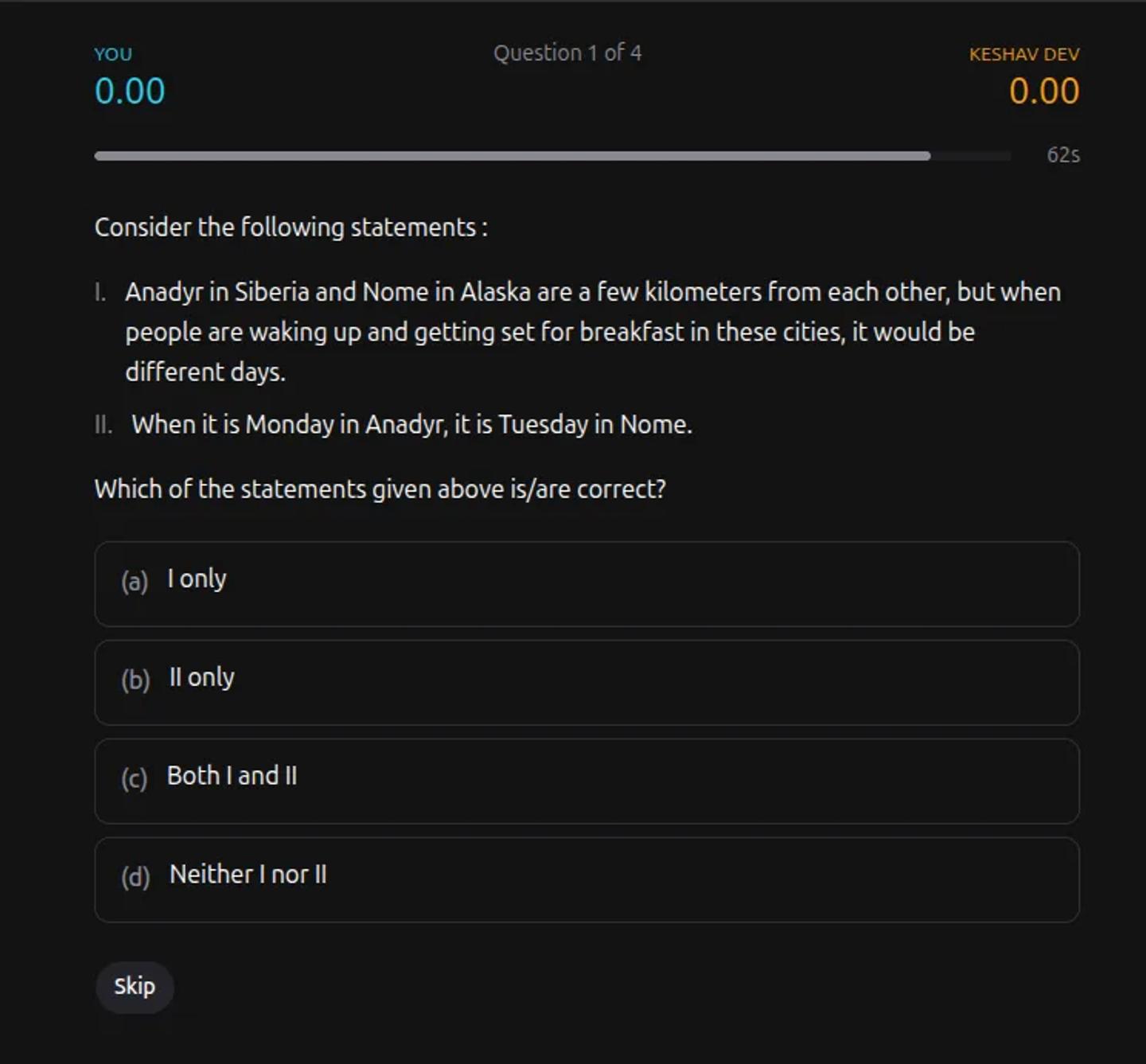
4. Skip is a real choice
Skip is a full-sized button beside Submit, not a small link at the bottom. This is on purpose. In Prelims, a good skip protects your score as much as a right answer adds to it. The rule from the maths is simple: if you are more than about one in four sure, attempting is worth it; if not, skip. The app does not punish you for skipping, and it does not reward you for rushing.
5. The result, and your rating
The higher total wins. Level marks are a draw. Each rated round changes your rating, which uses Glicko-2, the system Lichess uses for chess. Everyone starts at 1,200.
A draw is not a free result. Draw with a much stronger aspirant and your rating goes up; draw with a much weaker one and it goes down. Your rating settles at the end of every round, so you can stop after any round without losing anything.
The review: judging the decision, not only the answer
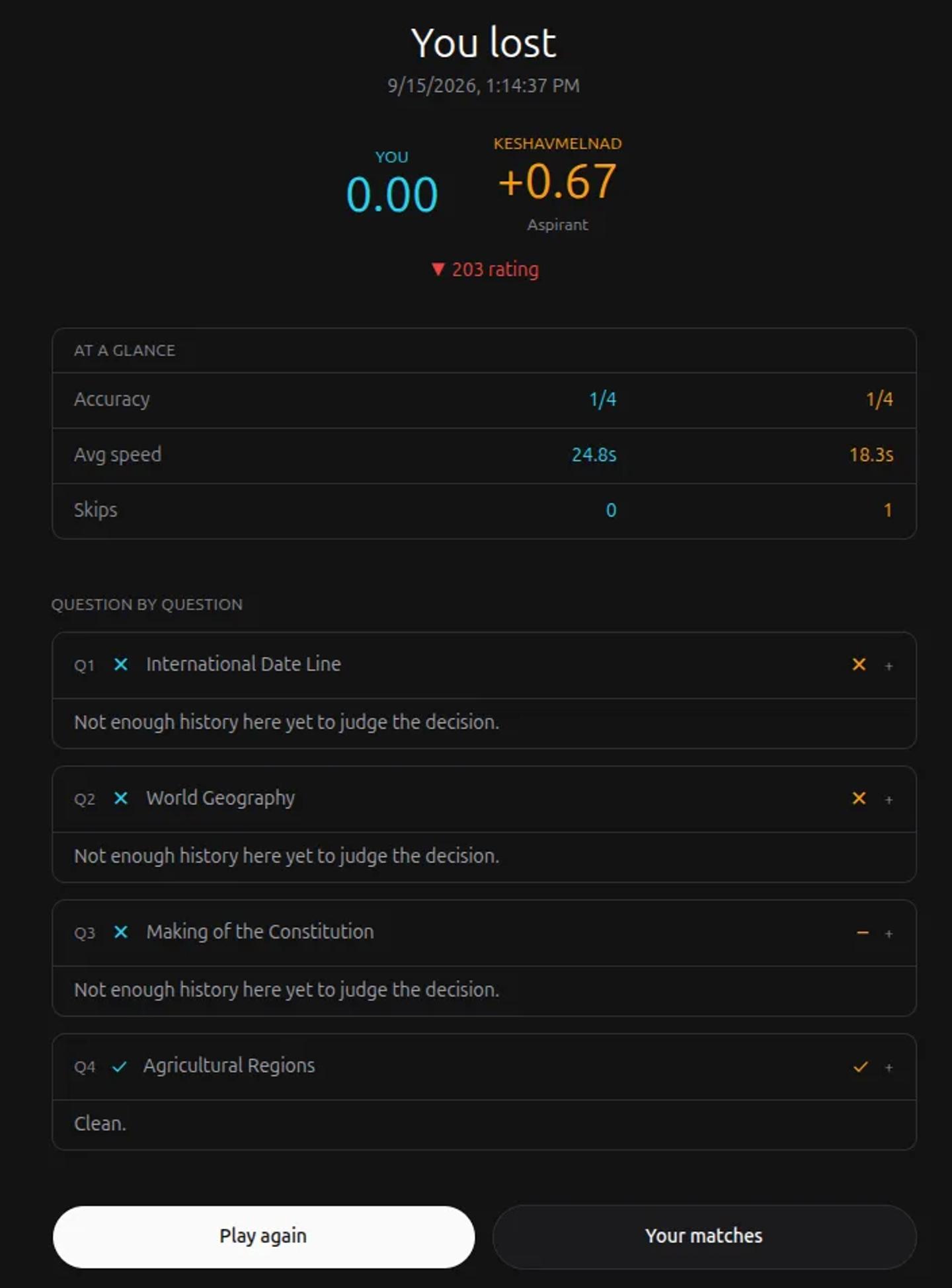
When the round ends, the review opens by itself. It shows each question, your answer, your opponent's answer, UPSC's official key and an explanation.
It also gives each decision a verdict, separately from whether you were right: a good skip, a risky attempt, or a timid skip in a topic where your own record says you usually get it right. These verdicts come from your past answers in that topic. Over many rounds, this is what improves your Prelims score: you learn where your "I think it's (b)" can be trusted, and where it cannot.
The one exception: Blitz
There is one format where time does matter, and it is kept separate. Blitz uses only short, direct questions with a short clock, and it has its own rating, apart from the main ladder. In Blitz, if the marks are level, the aspirant who used less time wins, and a skip counts as using the full time. If both marks and time are level, it is still a draw.
I kept Blitz apart for the same reason as everything above. Quick recall of short facts is a real skill, but it is not the same skill as judging a long statement question. Mixing the two in one rating would have meant rewarding speed in the main duel.
What a duel will not do
- It will not give you marks for speed.
- It will not show you the answer before the question closes.
- It will not let you pay for rating, or pay to remove a penalty.
- It will not help you in any way during a rated round.
All the rules are on the How it works page. If you want to try one round, open CollectorX and press Find an opponent. If you would rather start alone, Solo Learn has a Practice mode with the same marking.
Sources
- UPSC Civil Services (Preliminary) Examination 2025, General Studies Paper I — GS Paper I has 100 questions and two hours; a wrong answer loses one-third of the question's marks; a blank answer carries no penalty. (accessed 4 November 2026)
- UPSC Prelims negative marking: when a guess pays, with the maths (CollectorX) — A blind guess among four options is worth zero marks on average under UPSC's marking. (accessed 4 November 2026)
- How it works (CollectorX) — Matchmaking starts within 50 rating points and widens; a labelled, unrated practice bot is offered after fifteen seconds; the four paces and their question counts; difficulty scales the clock; same questions in the same order; the server owns the clock and the key is not sent before the question closes; a question closes early when both have answered; marking +2, −0.67, 0 with no bonus for speed; Skip is a full-sized button; a level round is a draw; Glicko-2 from 1,200; draws are priced by rating; rating settles every round; the review shows the key, explanations and decision verdicts from the player's own topic record; no assistance in a rated duel and nothing on the ladder for sale. (accessed 4 November 2026)
- CollectorX question bank — Every question in the CollectorX bank is a verbatim UPSC PYQ with UPSC's official answer key (queried 2026-11-05). (accessed 4 November 2026)
- CollectorX app — Blitz uses short questions, a short clock and its own rating; a level Blitz round goes to the player who used less time, with a skip charged the full time, and level on both is a draw. (accessed 4 November 2026)

Keshav Melnad
Prepared for the UPSC Civil Services Examination for six years before building CollectorX on his own. He holds a PhD from IIT Bombay, and his research on Sanskrit astronomical texts is published in peer-reviewed journals.
Read next
How CollectorX was built, phase by phase
CollectorX started on 20 August 2026 as solo practice on real UPSC Prelims PYQs with official answers. Rated duels came at the end of August, daily practice and Pro in October, and friends, full papers and Blitz in November. Here is each step, and why it came when it did.
How to use UPSC PYQs properly, not just solve them once
PYQs will not tell you which topics come next year: in 1,000 GS Paper I questions from 2016 to 2025, most topics were asked in only one year. What PYQs teach is how UPSC asks. Solve them topic-wise, learn why every wrong option is wrong, revisit your mistakes, and sit full papers near the exam.
Your next duel can start now.
Solve real Prelims PYQs against another aspirant, or practise alone with the exam's own marking.