How to use ChatGPT, Gemini and Claude for UPSC Prelims, and how to check what they tell you
Use an AI assistant to explain concepts, break a PYQ down statement by statement and test your recall. Never take a fact or a final answer from it without checking UPSC's official answer key or your standard book. All three companies say their assistants can be wrong.
 Keshav MelnadUpdated
I prepared for UPSC for six years. Today I build software, and I use AI assistants every working day. So I have seen both sides: how much they can help an aspirant, and how calmly they can give a wrong answer.
This post is about using ChatGPT, Gemini and Claude for Prelims in a way that makes you sharper, not lazier. The short version is simple. Let the assistant explain. Let UPSC's official key and your standard books decide.
What the companies themselves say
Before you trust any assistant, read what its own makers write about it.
- OpenAI's help page says ChatGPT "can produce incorrect or misleading outputs", and that it may sound confident even when it is wrong. Its own advice is to use ChatGPT "as a first draft, not a final source."
- Google's help page says Gemini "may sometimes produce inaccurate, offensive, or inappropriate information".
- Anthropic's help page says "Users should not rely on Claude as a singular source of truth".
This is not me being negative about AI. This is what the three companies write on their own help pages. Take them at their word.
Where an assistant really helps
Explaining a concept in simple words. If a chapter in Laxmikanth or the NCERT is not clear to you, ask the assistant to explain it as if you are in Class 10. Then ask follow-up questions until you can explain it back in your own words. Here the assistant is a patient teacher, not a source of facts.
Breaking a PYQ down, statement by statement. Paste a PYQ and ask: "Judge each statement separately. For each one, tell me if it is correct, why, and which topic I should revise." This teaches you more than another summary, because UPSC builds its statements from small, specific mistakes.
Testing your recall. After you finish a topic, ask: "Ask me five questions on this, one at a time. Don't tell me the answer until I reply." Answering from memory is what makes a topic stay.
Arranging your own notes. Paste your own notes and ask for a revision table. The facts come from you, so there is less room for invented ones. Still read the table once before you trust it.
Where it fails you
Exact facts. OpenAI lists "Incorrect definitions, dates, or facts" among the mistakes ChatGPT makes. In Prelims, many marks depend on exact facts: an article number, a schedule, the year of a report, the ministry behind a scheme. Never take one of these from an assistant without checking.
Recent events. An assistant learns from data up to a certain date. OpenAI says its models do not know about events after that, unless a tool such as search is used. Anthropic says Claude "may get confused when prompted about current events". Even when the assistant searches the web, open the sources it cites and read them yourself.
Sounding sure. OpenAI also says the model "may express high confidence even in incorrect answers". So don't judge an answer by its tone. A wrong answer and a right one sound the same.
Predicting the paper. No assistant can tell you what UPSC will ask next year. Only the old papers can show you how UPSC thinks.
Why this matters more after 2022
UPSC has changed how it asks. I counted every GS Paper I question from 2016 to 2025 in our question bank. That is 1,000 questions, all checked against UPSC's official answer keys. From 2016 to 2021, the paper had no questions of the "How many of the above are correct?" type. Then it had 8 in 2022, 47 in 2023, 17 in 2024 and 27 in 2025.
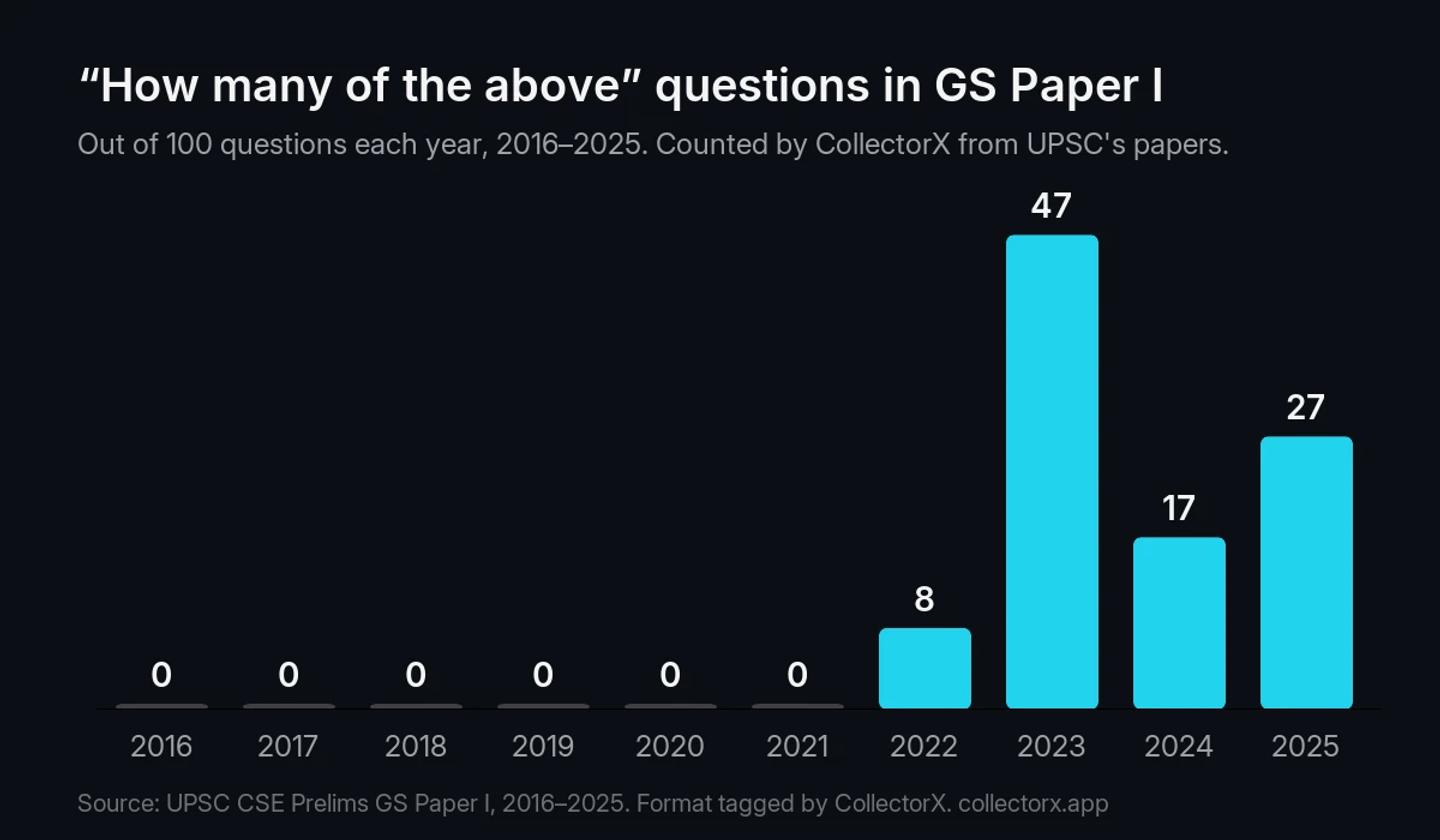
In the older format, you could often reach the answer by removing one or two options. In the "how many" format, that trick mostly stops working. You must judge every statement, and one wrong judgement changes the answer. If an assistant gets even one statement wrong, and you believe it, you don't just miss the two marks. UPSC also deducts one-third of the question's marks for a wrong answer.
A real PYQ: 2023, Question 9
Here is a question from the 2023 GS Paper I (Series A, Question 9).
Consider the following statements:
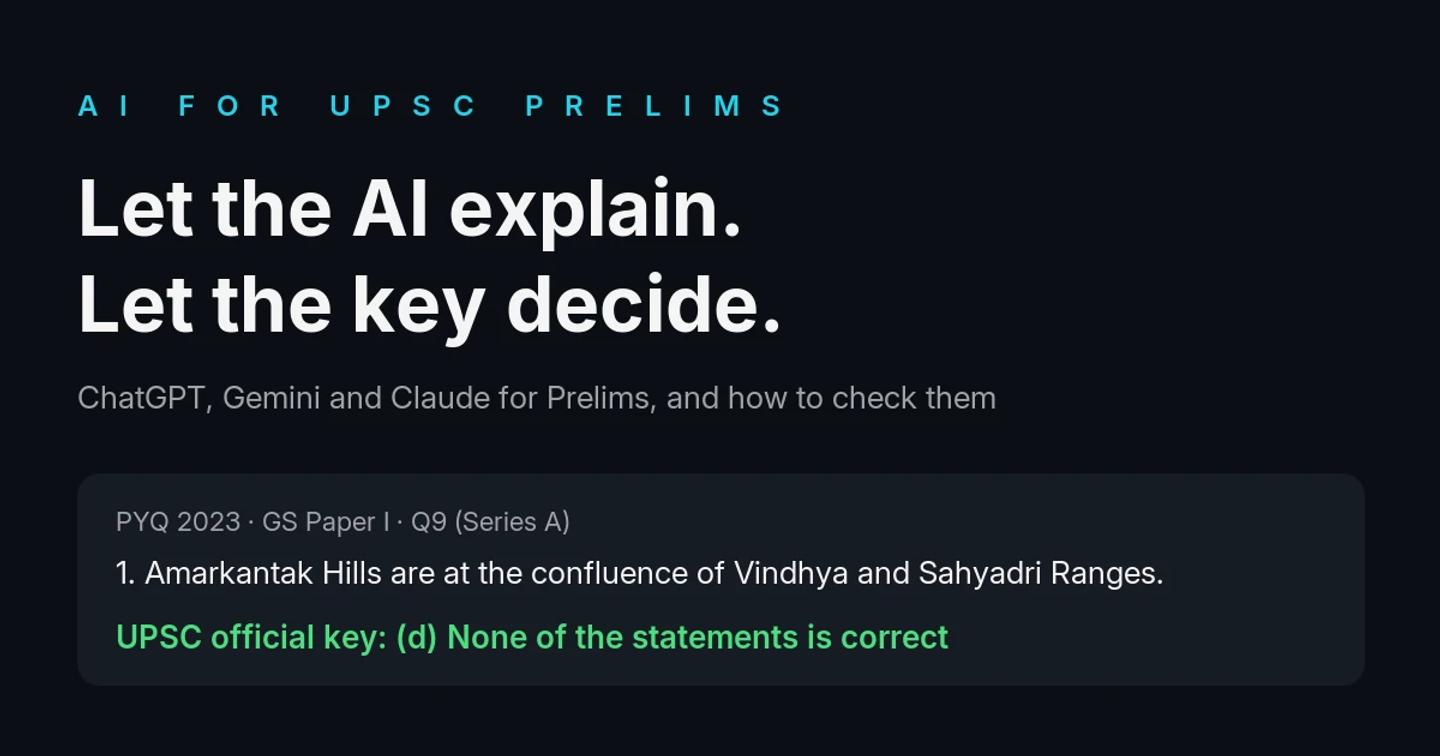
1. Amarkantak Hills are at the confluence of Vindhya and Sahyadri Ranges.
2. Biligirirangan Hills constitute the easternmost part of Satpura Range.
3. Seshachalam Hills constitute the southernmost part of Western Ghats.
How many of the statements given above are correct?
(a) Only one (b) Only two (c) All three (d) None
UPSC's official answer key gives (d) None. Every statement sounds like something you have read, because each one joins a real name to the wrong range:
- Amarkantak is in the Maikal Range of Madhya Pradesh. Britannica describes the Maikal Range as forming the eastern base of the Satpura Range. So the Satpura is involved here, not the Sahyadri.
- The Biligirirangan Hills are in Chamarajanagar district of Karnataka, near both the Eastern Ghats and the Western Ghats. That is far to the south of the Satpura Range.
- The Seshachalam Hills are part of the Eastern Ghats, in the Tirupati district of Andhra Pradesh. They are not in the Western Ghats at all.
Try this yourself. Paste the question into the assistant you use and read its answer. Then check each statement in your geography NCERT and an atlas, and check the final answer against the key above. Whatever the result, you will learn something: either the assistant was right and you now know why, or it was wrong and you now know where to be careful.
A five-step check for any AI answer
- Ask for each statement separately. "Judge statements 1, 2 and 3 one by one, with a reason for each." One combined answer hides the weak step.
- Ask where to verify it. "Which NCERT chapter or standard book covers this?" Then actually open that book. The assistant can name the wrong chapter too, so the book is the check, not the assistant's reference to it.
- Check the final answer only against UPSC's official key. Not a coaching key, and not a forum post. UPSC publishes its official key for each Prelims paper on upsc.gov.in. It comes late: the key for the 2023 paper is dated 9 May 2024, almost a year after the exam.
- When the assistant and the key disagree, the key wins. Then find out why they differ. That gap is exactly where your learning is.
- Write the corrected fact in your notes, in one line. "Amarkantak: Maikal Range, eastern base of the Satpura." Next time you revise, you will meet it again.
Prompts you can copy
Explain [topic] in simple English, as if I am in Class 10. Then ask me three questions to check that I understood.
Here is a UPSC Prelims PYQ. Judge each statement separately. For each one, say whether it is correct, give the reason, and name the NCERT chapter or standard book where I can verify it. Do not give the final option until you have judged every statement.
I got this PYQ wrong. My answer was (b) and the official key says (d). Explain where my thinking went wrong, statement by statement.
Ask me five questions on [topic], one at a time. Wait for my answer before you tell me if I am right.
Why I built CollectorX around the official key
When I was preparing, finding questions was never the hard part. Trusting the answers was. Books, coaching keys and forum posts sometimes disagree with UPSC, and you only find out after you have learnt the wrong thing.
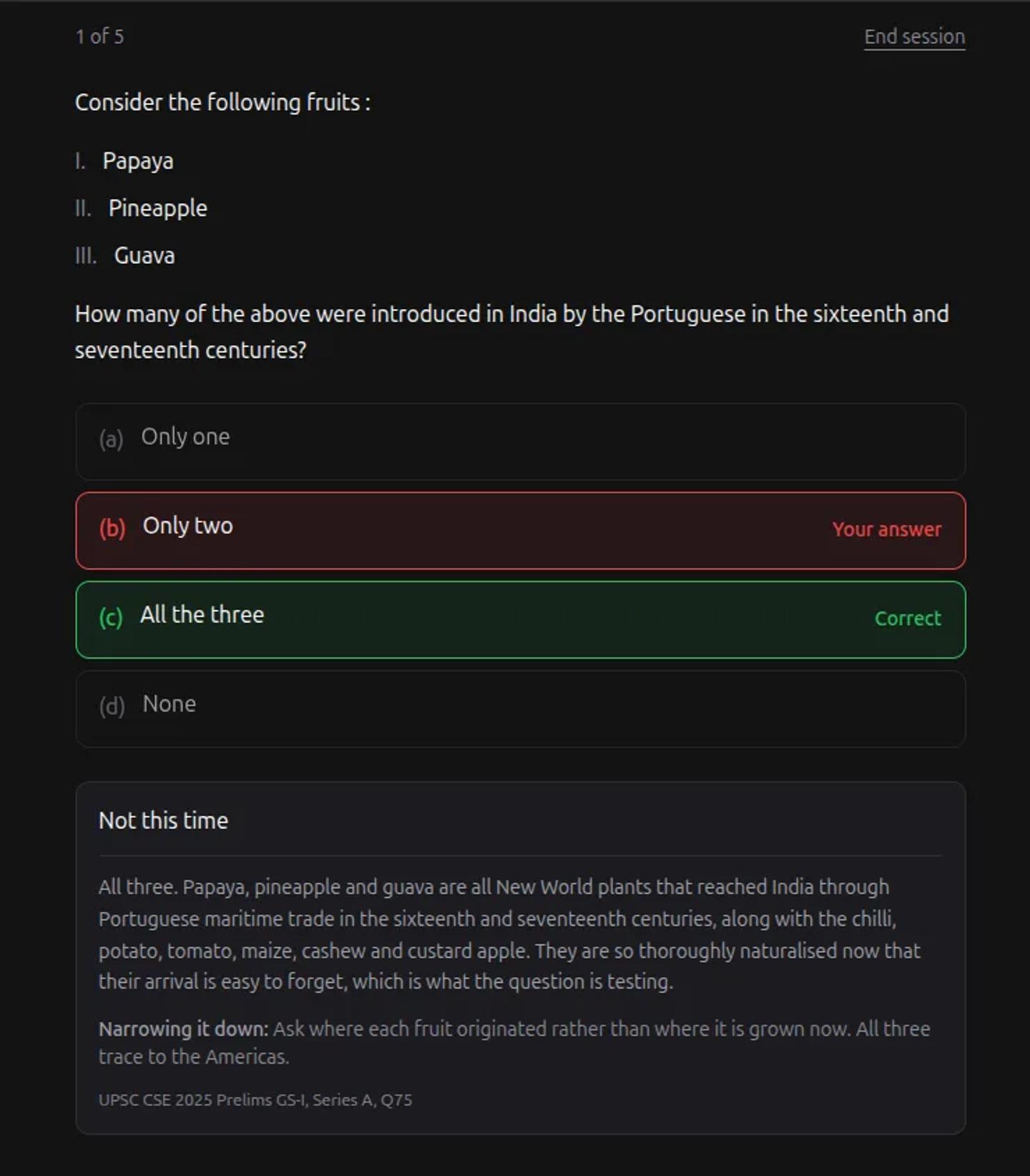
So in CollectorX, every PYQ carries UPSC's official answer, and after you answer, you see an explanation of the correct option. You can practise alone in Solo Learn, at your own pace, or solve the same questions as another aspirant in a duel.
Use the assistant like a good classmate. Ask it, discuss with it, even argue with it. But when it is time to decide the answer, open the key.
Sources
- Does ChatGPT tell the truth? (OpenAI Help Center) — ChatGPT can produce incorrect or misleading outputs, may sound confident when wrong, and should be used as a first draft, not a final source. (accessed 4 November 2026)
- Does ChatGPT tell the truth? (OpenAI Help Center) — ChatGPT's mistakes include incorrect definitions, dates or facts; its models do not know events after their training cutoff unless tools such as search are used; it may express high confidence in incorrect answers. (accessed 4 November 2026)
- Learn about responses from Gemini Apps (Gemini Apps Help) — Gemini may sometimes produce inaccurate, offensive, or inappropriate information. (accessed 4 November 2026)
- Claude is providing incorrect or misleading responses. What's going on? (Claude Help Center) — Users should not rely on Claude as a singular source of truth; Claude may get confused about current events. (accessed 4 November 2026)
- Civil Services (Preliminary) Examination 2023, General Studies Paper I (UPSC) — The text of 2023 GS Paper I, Question 9 (Series A); one-third of a question's marks is deducted for a wrong answer, and a blank answer carries no penalty. (accessed 4 November 2026)
- CS-P-2023 Answer Key, General Studies Paper I (UPSC) — UPSC's official key for 2023 GS Paper I, Series A, gives (d) for Question 9; the paper has 100 questions for 200 marks; the key file is dated 9 May 2024. (accessed 4 November 2026)
- Maikal Range (Britannica) — The Maikal Range forms the eastern base of the Satpura Range. (accessed 4 November 2026)

Keshav Melnad
Prepared for the UPSC Civil Services Examination for six years before building CollectorX on his own. He holds a PhD from IIT Bombay, and his research on Sanskrit astronomical texts is published in peer-reviewed journals.
Read next
How a CollectorX duel works, and why speed earns no marks
A CollectorX duel is marked exactly like UPSC Prelims: +2 for a right answer, −0.67 for a wrong one, 0 for a skip, and nothing for answering faster. If the marks are level, the round is a draw. Here is how a round works, step by step, and why speed decides nothing.
How to use UPSC PYQs properly, not just solve them once
PYQs will not tell you which topics come next year: in 1,000 GS Paper I questions from 2016 to 2025, most topics were asked in only one year. What PYQs teach is how UPSC asks. Solve them topic-wise, learn why every wrong option is wrong, revisit your mistakes, and sit full papers near the exam.
Your next duel can start now.
Solve real Prelims PYQs against another aspirant, or practise alone with the exam's own marking.