How to use UPSC PYQs properly, not just solve them once
PYQs will not tell you which topics come next year: in 1,000 GS Paper I questions from 2016 to 2025, most topics were asked in only one year. What PYQs teach is how UPSC asks. Solve them topic-wise, learn why every wrong option is wrong, revisit your mistakes, and sit full papers near the exam.
 Keshav Melnad
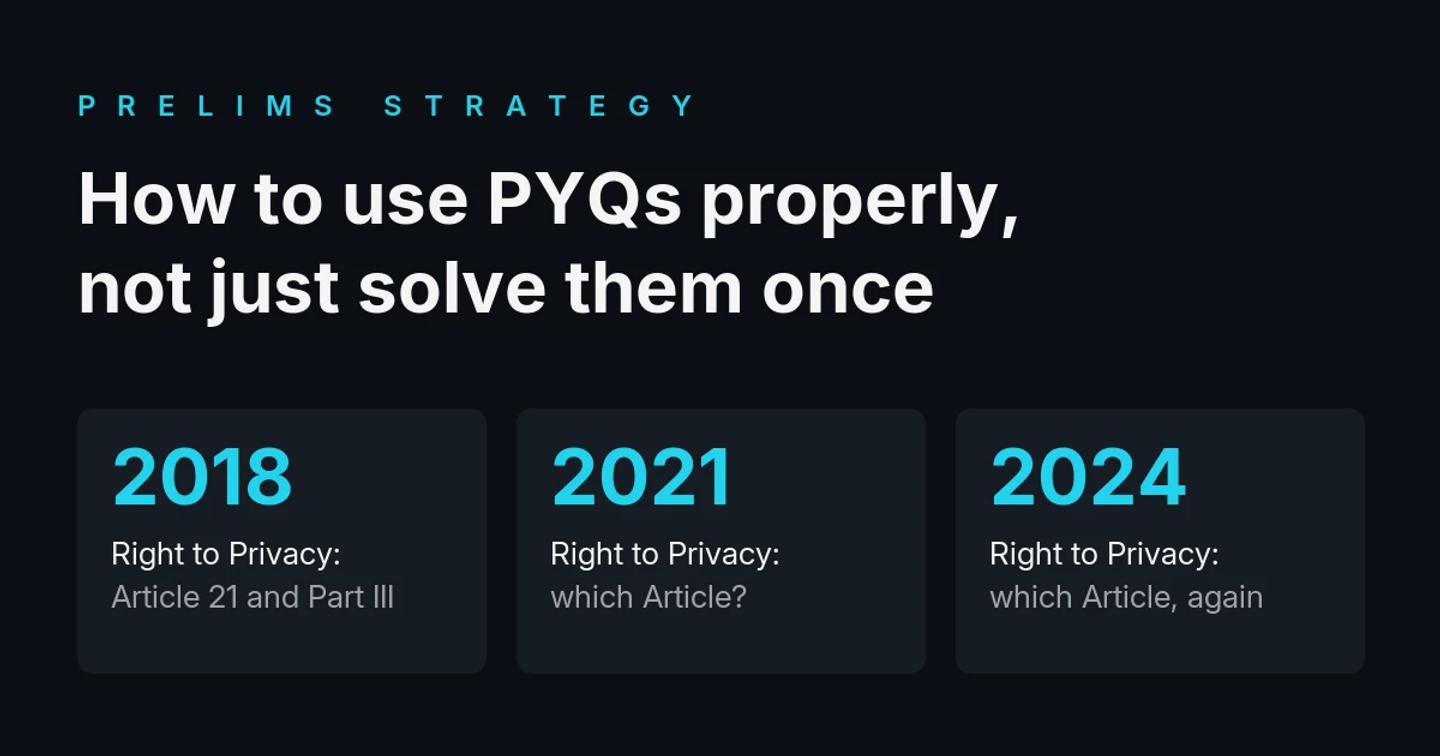
In 2018, UPSC asked which provisions of the Constitution imply that the Right to Privacy is protected as part of the Right to Life and Personal Liberty. In 2021, it asked which Article protects the Right to Privacy. In 2024, it asked under which Article the Supreme Court has placed the Right to Privacy. The answer all three times was Article 21.
An aspirant who solved the 2018 question properly, and understood why each of the other options was wrong, had the 2021 and 2024 questions almost free. An aspirant who only ticked (c), checked the key and moved on, had to learn it again.
That is the whole difference between solving PYQs and using them. This post shows what our own count of ten years of papers says, and the method I would follow.
First, what PYQs will not do
Many pages say "topics repeat in UPSC". Some do. But I wanted to see how often, so I counted.
CollectorX has every GS Paper I question from 2016 to 2025, which is 1,000 questions, each with UPSC's official answer. Every question is tagged with a topic: an AI proposes the topic, and a human checks and approves it. Across the ten years, the 1,000 questions fall into 517 topics.
- 289 topics were asked in only one year out of ten.
- 138 topics came back in a second year.
- Only 37 topics were asked in four years or more.
- Just one topic, Fundamental Rights, was asked in seven of the ten years.
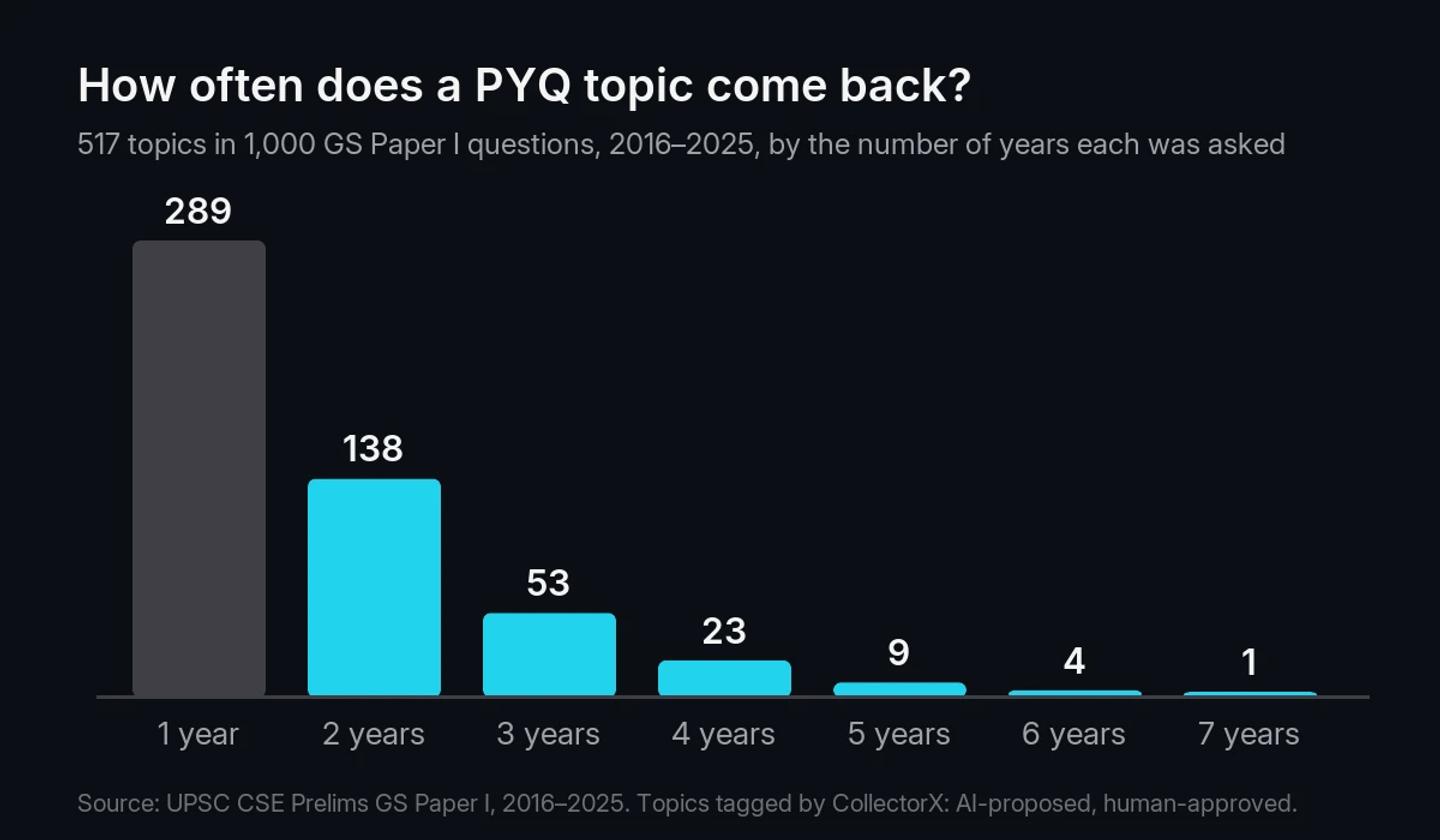
These numbers depend on how finely the topics are split. If you split them more broadly, more topics would repeat. But the shape will not change much: UPSC spreads its 100 questions across a very wide syllabus, and it does not follow a fixed list. So if you use PYQs to guess next year's topics, you will be disappointed.
Subjects are a different story. Every subject appeared in all ten papers. Over the ten years, the 1,000 questions split like this:
- Economy: 184
- Polity and Governance: 178
- Environment and Ecology: 163
- History and Culture: 162
- Science and Technology: 130
- Geography: 103
- Current Affairs: 80
But even the subject counts swing from year to year: Polity had between 12 and 25 questions in a paper, Environment between 10 and 22, and Geography between 5 and 17. So no subject can be left out, and no subject is safe to predict. PYQs do not tell you which chapter to read twice.
What PYQs do teach: how UPSC asks
If PYQs cannot tell you what will come, why solve them at all? Because they show you how UPSC asks, and that changes much more slowly than the topics.
Look at the 2025 paper. Only 17 of its 100 questions were simple one-line questions. The rest were in formats that test exact knowledge: 42 asked which statements are correct, 27 asked how many statements or pairs are correct, and 14 were two-statement questions where you judge whether one statement explains the other. In 2021 there were no "how many of the above" questions at all, and in 2023 there were 47. I wrote about this change in my post on AI tools for UPSC Prelims.
So PYQs train you for the shape of the paper: long statements, close options, and details that a casual reading misses. That training is the real value.
The method: four passes over the same questions
Pass 1: solve topic-wise, while you read
Do not keep PYQs for the end. When you finish a chapter, say Fundamental Rights in Laxmikanth, solve every PYQ on that topic from the last ten years on the same day. You will see at once which lines of the chapter UPSC actually cared about. When you revise that chapter, read those lines more carefully.
Pass 2: learn why every wrong option is wrong
This is the pass most aspirants skip, and it is the most useful one. For every question, write one line on each option: why it is right, or why it is wrong. Take the 2018 question:
Right to Privacy is protected as an intrinsic part of Right to Life and Personal Liberty. Which of the following in the Constitution of India correctly and appropriately imply the above statement ?
(a) Article 14 and the provisions under the 42nd Amendment to the Constitution
(b) Article 17 and the Directive Principles of State Policy in Part IV
(c) Article 21 and the freedoms guaranteed in Part III
(d) Article 24 and the provisions under the 44th Amendment to the Constitution
UPSC's answer is (c). Now go option by option and look at the Articles:
- Article 14 is equality before law.
- Article 17 abolishes untouchability.
- Article 21 is protection of life and personal liberty.
- Article 24 prohibits the employment of children in factories.
The question itself says "Right to Life and Personal Liberty", so Article 21 is the only Article that fits. Now look at the 2021 and 2024 questions. Their options were Articles 15, 16, 19, 21 and 29. If, after 2018, you had also noted what 15, 16, 19 and 29 are, you would have known every option in both later questions:
- Article 15 prohibits discrimination on grounds of religion, race, caste, sex or place of birth.
- Article 16 is equality of opportunity in public employment.
- Article 19 protects certain freedoms, such as the freedom of speech.
- Article 29 protects the interests of minorities.
One question, studied this way, taught you eight Articles of Part III. Solved only once, it taught you one letter.
Pass 3: revisit your mistakes after growing gaps
Keep a list of the questions you got wrong, and also the ones you got right but were not sure about. The second group matters as much as the first, because in the exam an unsure answer can easily become a wrong one.
Do not revise this list every day. Come back to it after a few days, then after a week or two, then after a month. Each time you get a question right, the gap can grow. Each time you get it wrong, start that question again. This is slower to set up, but the facts stay with you much longer than with one long revision before the exam.
Pass 4: sit full papers under exam conditions
Topic-wise solving teaches the content. It does not teach you to handle 100 mixed questions in 120 minutes, where a polity question is followed by an ecology question and then an economy one. In the last two or three months before Prelims, sit full PYQ papers at the same time of day as the exam, with a timer, and mark them with UPSC's marking: +2 for a right answer, −0.67 for a wrong one, and 0 for a skip. My post on negative marking explains when a guess is worth it.
After each paper, do pass 2 again for every question you got wrong or skipped.
The limits of this method
PYQs are UPSC's own questions, so they are the best practice material you have. But ten years is only 1,000 questions, and the syllabus is far larger than that. PYQs show you how deep to read. They do not replace the reading. And current affairs questions age quickly: a scheme from 2017 may not matter in 2027, even though the way UPSC asked about it still does.
How I built this into CollectorX
I built CollectorX around these four passes, with UPSC's official key on every question. In Solo Learn you can pick a topic or a year and practise with an explanation after each answer. With Pro, the questions you get wrong or save come back in Revision at growing gaps. And the full Prelims paper gives you 100 questions in 120 minutes with UPSC's marking; one paper a month is free. If you want to start, open Solo Learn after your next chapter and solve that topic's PYQs the same day.
Sources
- UPSC Civil Services (Preliminary) Examination 2018, General Studies Paper I — 2018 GS Paper I, Series A, question 92: the Right to Privacy question with options pairing Articles 14, 17, 21 and 24; UPSC's official answer is (c), Article 21 and the freedoms guaranteed in Part III. (accessed 4 November 2026)
- UPSC Civil Services (Preliminary) Examination 2021, General Studies Paper I — 2021 GS Paper I, Series A, question 79: which Article protects the Right to Privacy (options Articles 15, 19, 21, 29); UPSC's official answer is (c), Article 21. (accessed 4 November 2026)
- UPSC Civil Services (Preliminary) Examination 2024, General Studies Paper I — 2024 GS Paper I, Series A, question 76: under which Article the Supreme Court has placed the Right to Privacy (options Articles 15, 16, 19, 21). (accessed 4 November 2026)
- UPSC answer key, Civil Services (Preliminary) Examination 2024, General Studies Paper I — UPSC's official answer to 2024 GS Paper I, Series A, question 76 is (d), Article 21. (accessed 4 November 2026)
- UPSC Civil Services (Preliminary) Examination 2025, General Studies Paper I — In the 2025 GS Paper I, 17 questions were simple one-line questions, 42 asked which statements are correct, 27 asked how many statements or pairs are correct, and 14 were Statement I / Statement II questions (counted by CollectorX). (accessed 4 November 2026)
- Part III, Constitution of India (CLPR) — Titles of Articles 14, 15, 16, 17, 19, 21, 24 and 29 in Part III of the Constitution. (accessed 4 November 2026)
- How to use ChatGPT, Gemini and Claude for UPSC Prelims (CollectorX) — “How many of the above” questions: none from 2016 to 2021, 47 in 2023. (accessed 4 November 2026)

Keshav Melnad
Prepared for the UPSC Civil Services Examination for six years before building CollectorX on his own. He holds a PhD from IIT Bombay, and his research on Sanskrit astronomical texts is published in peer-reviewed journals.
Read next
How a CollectorX duel works, and why speed earns no marks
A CollectorX duel is marked exactly like UPSC Prelims: +2 for a right answer, −0.67 for a wrong one, 0 for a skip, and nothing for answering faster. If the marks are level, the round is a draw. Here is how a round works, step by step, and why speed decides nothing.
UPSC Prelims negative marking: when a guess pays, with the maths
In UPSC Prelims a wrong answer costs two-thirds of a mark, so a blind guess among four options is worth exactly zero on average. Cut one wrong option and a guess is worth +0.22; cut two and it is worth +0.67. Guess only when you are more than 25% sure.
Your next duel can start now.
Solve real Prelims PYQs against another aspirant, or practise alone with the exam's own marking.