How CollectorX was built, phase by phase
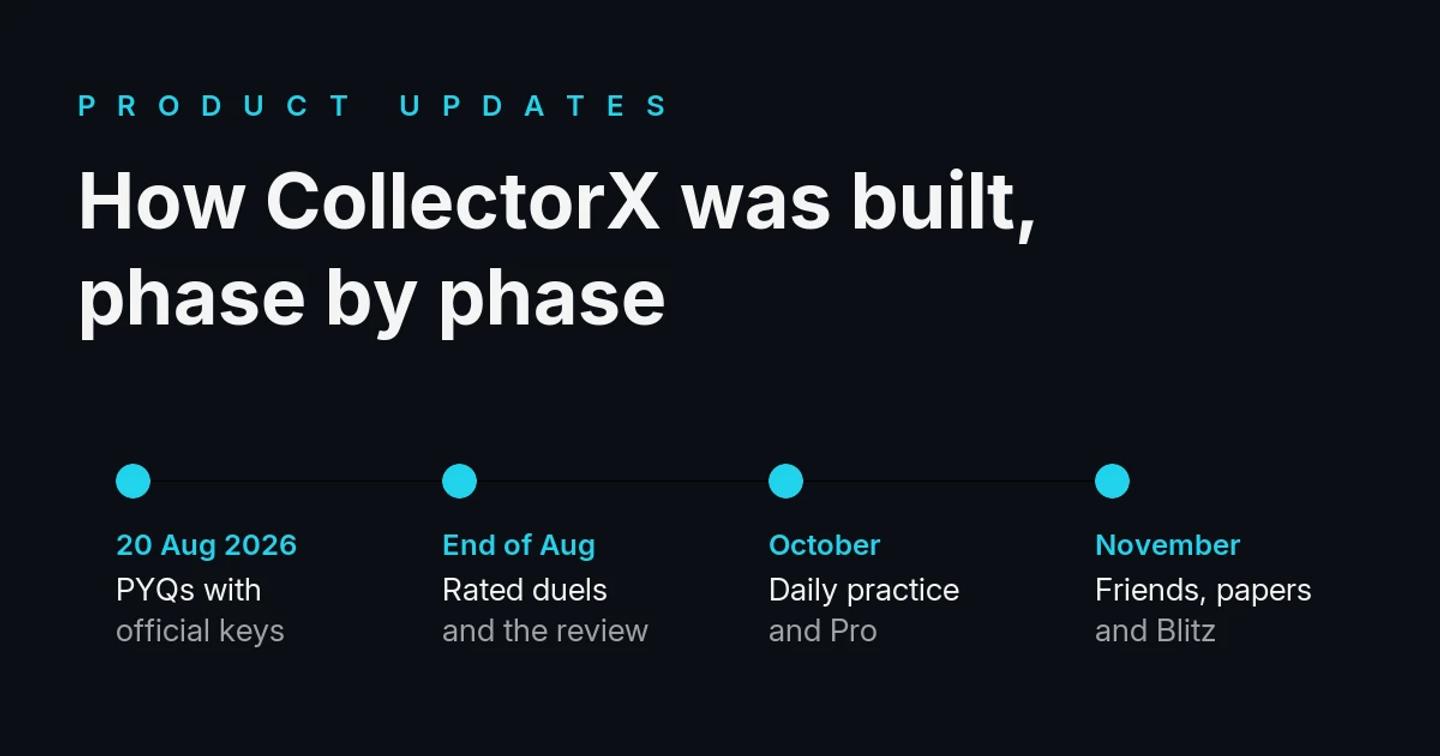
CollectorX started on 20 August 2026 as solo practice on real UPSC Prelims PYQs with official answers. Rated duels came at the end of August, daily practice and Pro in October, and friends, full papers and Blitz in November. Here is each step, and why it came when it did.
 Keshav MelnadUpdated
I prepared for UPSC for six years. In those years, two things troubled me again and again. First, practising alone gave me no honest measure of where I stood. Second, I could never be fully sure of the answers in my books and test series, because they did not always agree with UPSC.
CollectorX is my answer to both problems. I built it alone, one piece at a time, and each piece reached aspirants before I started the next. This post is the story of those pieces, in order, with the reason behind each one.
20 August 2026: PYQs with UPSC's own answers
The first version was simple. A landing page, and a single-player quiz of about 100 real Prelims questions, each with the answer from UPSC's official key. There were no opponents and no ratings yet.
I started here on purpose. Everything else in CollectorX depends on one thing: that the answer shown to you is the answer UPSC gave. If the answers are not right, a rating built on them means nothing.
The question bank has grown since then. Today it holds every GS Paper I question from 2016 to 2025, which is 1,000 questions, and every one carries UPSC's official answer. The 2021 and 2022 papers were the last to be added, in October.
End of August: the duel
The duel is the heart of CollectorX. You press one button, and the app finds an aspirant near your rating. You both get the same questions, in the same order, with the same time. If nobody suitable is online after fifteen seconds, you are offered a practice bot, clearly labelled and unrated. You are never told a bot is a person.
The marking is exactly UPSC's: +2 for a correct answer, −0.67 for a wrong one, and 0 for a skip. Answering faster earns nothing. If the marks are level, the round is a draw. I made this choice deliberately. Rewarding speed would train fast guessing, and fast guessing is what destroys a Prelims score under negative marking.
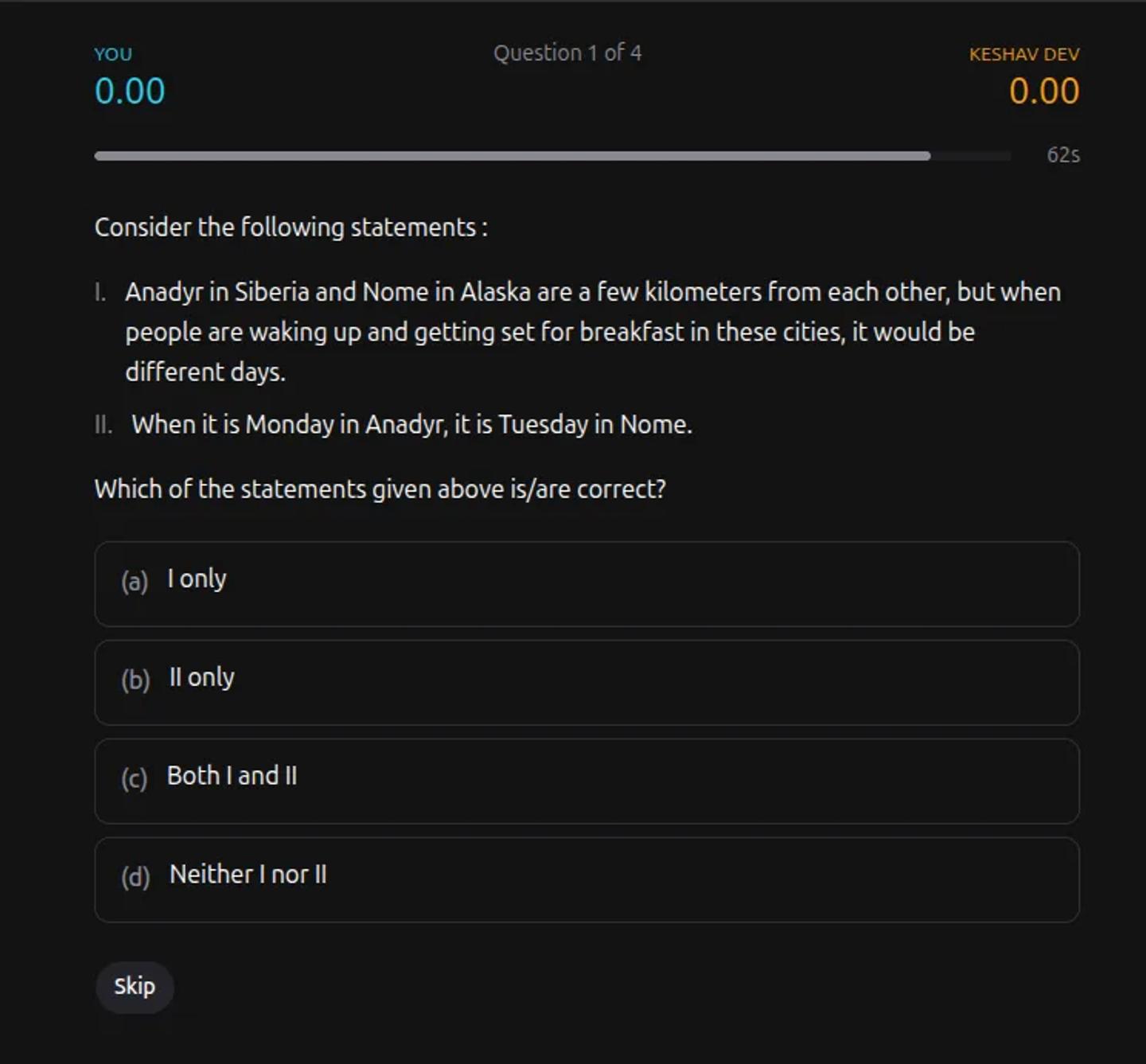
You also choose your pace. Brisk, Standard, Steady or Exam pace: slower paces give more time per question and fewer questions per round. And when a round ends, you can continue against the same opponent with fresh questions.
The review after every round
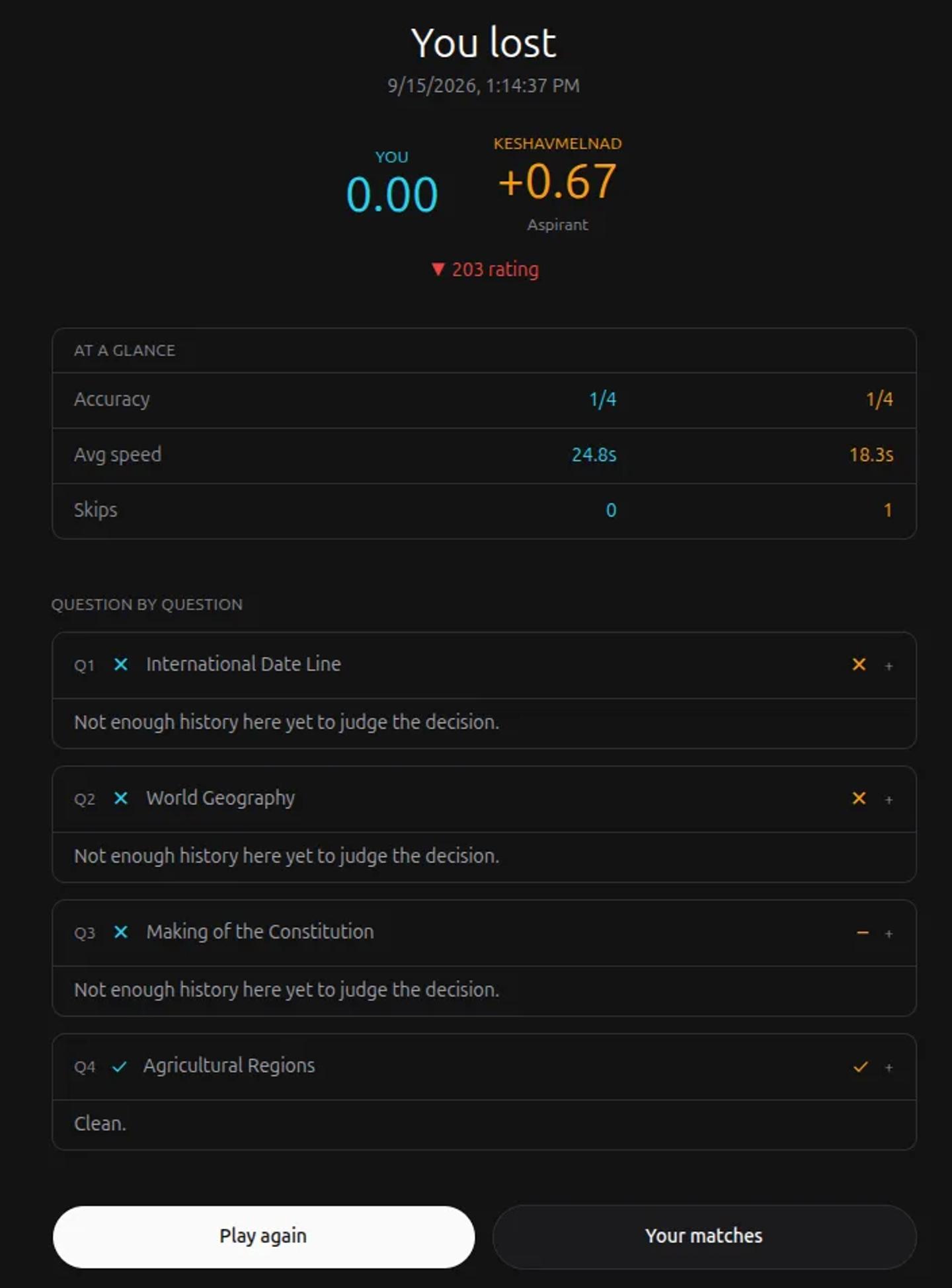
When a round ends, the review opens by itself. It shows every question, your answer, your opponent's answer, UPSC's official key, and an explanation.
It also judges your decision, separately from whether you were right. A good skip, a risky attempt, a timid skip in a topic you usually get right: these verdicts come from your own record in that topic. In Prelims, knowing when not to answer is as important as knowing the answer, and I wanted that skill to be visible.
The rating and the ladder
Every rated round moves your rating. CollectorX uses Glicko-2, a rating system used for chess on Lichess. Everyone starts at 1,200. Beating a stronger aspirant moves you up a long way; losing to a weaker one moves you down a long way. Your first ten rated rounds are calibration, so no rank is shown until they are done.
There are ten ranks, from Aspirant and Probationer up to District Collector and, at the top, Cabinet Secretary. Each rank has three steps, so your progress shows week by week, not once a season. These are CollectorX labels for rating bands, not real appointments.
Your match archive, accuracy by subject and rating graph are all on your profile, and there is a public leaderboard. Solo Learn came at the same time. You choose a subject, a year or a topic, and practise alone: in Learn mode with an explanation after every answer, or in Practice mode with UPSC's marking.
October: a reason to come back each day
Preparation is daily work, so the next step was daily habits.
- PYQ of the Day: one question every day, the same for everyone. You can try it even without signing in.
- A streak with rest days: your streak holds up to two rest days, which cover a missed day automatically, and you earn one back for every seven days you keep it. One bad day does not wipe out weeks of work, and rest days can never be bought.
- Duel Hour: if you turn it on, one reminder at 9 pm IST, so that aspirants come online at the same hour and find each other.
- Revision: questions you got wrong or saved come back to you on a schedule, at growing gaps, so you meet them again before they fade.
- Today's goals and achievements: three small goals a day, and badges for real milestones.
- Coins: you earn them by playing and by finishing goals, and spend them on name colours and profile banners. They can never be bought with money, and they never appear on a duel, a result or a review.
In October, CollectorX also started its paid plan, Pro. Duels, your rating, Solo Learn, the PYQ of the Day, and the answers and explanations on every question stay free. Pro adds a deeper reading of your own record. I will write a separate post on exactly what is free and what Pro adds.
November: friends, full papers and a faster format
The latest step makes CollectorX more social, and closer to the real exam.
- Echo: you can play against a real aspirant's earlier round: the same questions, and the answers they actually gave. It helps most when few people are online. Echo rounds are unrated and clearly marked.
- Friends: you can follow other aspirants, see your head-to-head record with the people you meet often, and invite a friend who is online to a live duel. Or share a six-character challenge code on WhatsApp. Friend duels are unrated.
- The full Prelims paper: a whole PYQ paper, 100 questions in 120 minutes with UPSC's marking, just like the exam hall. When you submit, you see how your score compares with others who took the same paper.
- The crowd line: once enough aspirants have answered a question, you can see how many got it right, and which wrong option was chosen most often.
- A weekly report and attempt coaching: a summary of your week, and advice from your own record on when attempting a question pays and when skipping is better.
- Difficulty from real answers: a question's difficulty is now set by how aspirants actually answered it, not by a guess.
- Blitz: a faster format with short, direct questions, a short clock on each, and its own separate rating. It is the one format where time breaks a level score.
- Postings: as you finish placement, climb the ladder and keep playing, you receive district postings from India's Aspirational Districts, one at a time.
What has not changed
Some rules have stayed the same since the first day, and they will stay:
- Every answer comes from UPSC's official key.
- In rated duels, speed earns no marks.
- Nothing on the ladder is for sale. You cannot pay for rating, and you cannot pay to remove a penalty.
- There is no help of any kind during a rated duel.
If you want to see how a duel works in detail, the How it works page has every rule. If you would rather start alone, open Solo Learn and pick a subject you are weak in. That is how I would start.
Sources
- How it works (CollectorX) — Matchmaking starts near your rating and offers a clearly labelled, unrated practice bot after fifteen seconds; marking is +2, −0.67 and 0 with no bonus for speed; a level round is a draw; the four paces; rating uses Glicko-2 from 1,200 with ten calibration rounds; the review shows every answer, the official key, explanations and a decision verdict from your own topic record; nothing on the ladder is for sale and there is no assistance during a rated duel. (accessed 4 November 2026)
- CollectorX home page — The ten ranks from Aspirant to Cabinet Secretary, each with three steps; rank names are CollectorX labels, not civil-service appointments; Solo Learn by subject, year or topic, with explanations or with Prelims marking. (accessed 4 November 2026)
- Pricing (CollectorX) — Duels, rating and rank, Solo Learn, the daily PYQ, Duel Hour, and correct answers and explanations on every question are always free; Pro adds a deeper reading of your own record. (accessed 4 November 2026)
- CollectorX app — PYQ of the Day, streak rest days, Duel Hour, revision, today's goals, achievements, coins and the shop, Echo, follows and rivalries, live friend invites, challenge codes, the full Prelims paper, the crowd line, the weekly report, attempt coaching, Blitz and Postings, as they work in the app. (accessed 4 November 2026)

Keshav Melnad
Prepared for the UPSC Civil Services Examination for six years before building CollectorX on his own. He holds a PhD from IIT Bombay, and his research on Sanskrit astronomical texts is published in peer-reviewed journals.
Read next
How a CollectorX duel works, and why speed earns no marks
A CollectorX duel is marked exactly like UPSC Prelims: +2 for a right answer, −0.67 for a wrong one, 0 for a skip, and nothing for answering faster. If the marks are level, the round is a draw. Here is how a round works, step by step, and why speed decides nothing.
How to use UPSC PYQs properly, not just solve them once
PYQs will not tell you which topics come next year: in 1,000 GS Paper I questions from 2016 to 2025, most topics were asked in only one year. What PYQs teach is how UPSC asks. Solve them topic-wise, learn why every wrong option is wrong, revisit your mistakes, and sit full papers near the exam.
Your next duel can start now.
Solve real Prelims PYQs against another aspirant, or practise alone with the exam's own marking.